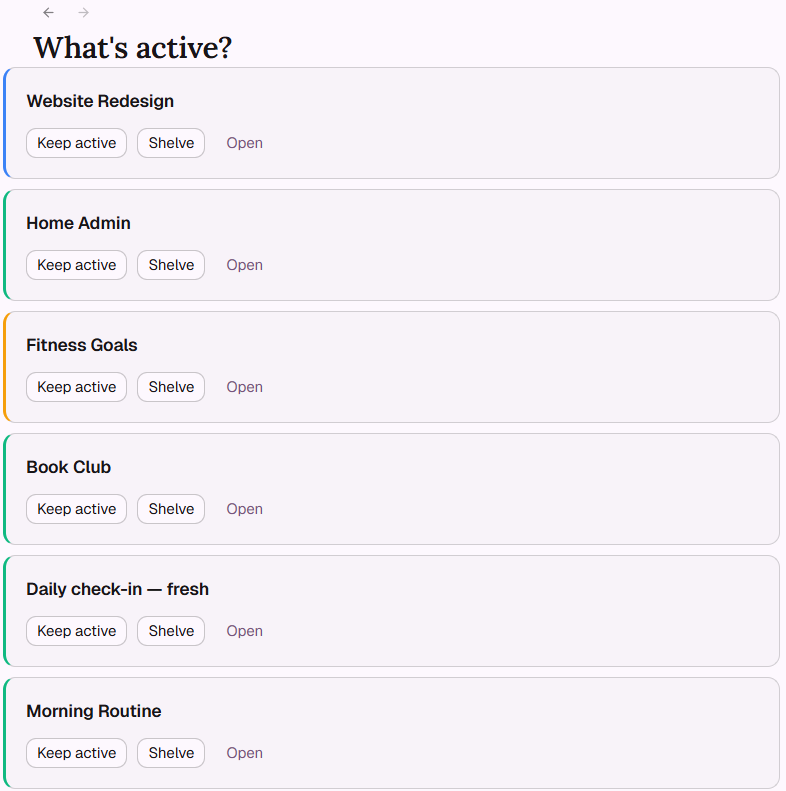
What it is. When you open Checked Off after an absence, the app does not drop you back into your full task list. It runs a tiered re-engagement flow sized to how long you’ve been away. A weekend gets a light reorientation. A week gets a gentle summary of what was going on. Two weeks or more gets a soft reintroduction that lets you add a few tasks and stop there without facing the prior state at all. A month or more opens with a guided project review - keep active, shelve, archive - and you have to explicitly choose to bypass it.
The problem it solves. Every other task manager treats return as resumption. You come back, the list is exactly where you left it, and the first thing the tool does is present the accumulated weight of what was going on weeks or months ago. That weight is the single most reliable predictor of app abandonment. People stop opening the app because opening it is punishing.
There is also a subtler problem. Even when you return and nothing looks different, something has changed inside your head - the task you were in the middle of is no longer loaded. Picking it back up costs more than finishing it would have cost if you’d never left.
The research behind it. Psychologists have a name for the cost of re-entering interrupted work: resumption lag (Altmann and Trafton, 2002). When you leave a task and come back, it takes measurable time and effort to reconstruct the context, the goal, and the next step. Sophie Leroy’s work on attention residue (Leroy, 2009) showed that part of your attention stays stuck on the unfinished prior task, degrading performance on whatever you’re trying to do now. Gloria Mark’s field research found knowledge workers averaged about 23 minutes to return to full task engagement after an interruption (Mark, Gudith, and Klocke, 2008).
The common thread: returning to work after time away is not free. It has a real cost, and the cost scales with how much unfinished complexity is waiting for you.
Checked Off’s welcome back flow is built on this finding. Instead of asking you to pay the full re-entry cost on return, the app absorbs some of it. Absence becomes a natural trigger for the project review you would otherwise never do on your own - which is where most stale complexity quietly accumulates in every other tool.