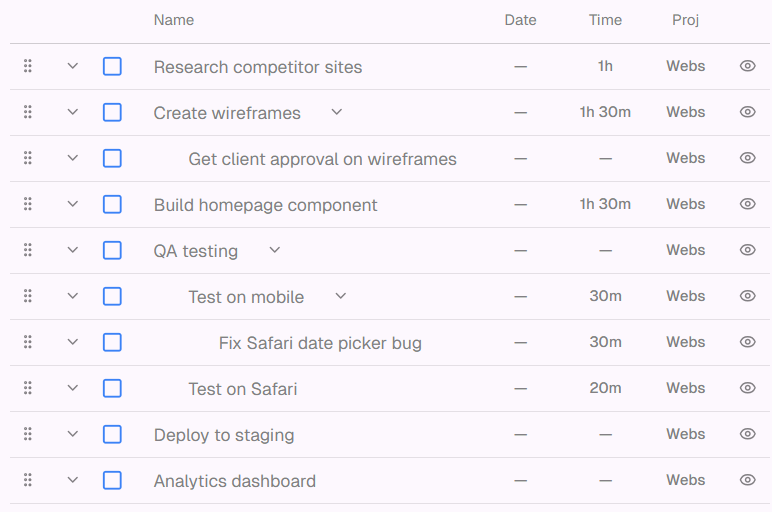
What it is. In Checked Off, tasks do not have a date assigned to them. They live in projects. When you plan your day, you activate projects and pull their top-of-list next-action-tagged tasks into your daily view. If you don’t finish a task, nothing happens to it. It stays where it was - in the project. The next day’s daily planning surfaces it again if you want it.
There is no rollover. There is no “today” field. There is no date-based failure.
The problem it solves. Every other task manager assigns tasks to days, and every other task manager then has to decide what to do when a task doesn’t get done on its assigned day. The two common answers are bad. Auto-rollover carries the task forward, day after day, accumulating an increasingly stale stack of overdue items and a guilt debt attached to each. Manual rescheduling forces the user to keep rewriting dates for tasks that never belonged to dates in the first place. Both treat “unfinished” as equivalent to “failed against a deadline” - when for most tasks, no deadline actually exists. The date was invented by the tool.
The research behind it. Research on procrastination and emotional regulation (Sirois and Pychyl, 2013) shows that tools which produce a constant drip of “overdue” framing increase avoidance behavior. The date-attached task model generates this framing continuously, even for tasks where being “late” is a meaningless concept - there was no actual due date, just a date the user picked during planning because the tool required one.
Research on the cognitive cost of unfinished tasks (the Zeigarnik tradition, 1927) complicates the picture: unfinished tasks do occupy attention, but they do so whether or not the tool is yelling at you about them. Adding a red “overdue” flag does not resolve the underlying cognitive load. It just adds affect to it.
The Checked Off model matches how tasks actually live in a person’s life. A task belongs to a project, because that’s what it’s for. It becomes relevant to today when you activate its project in daily planning. It stops being relevant when the day ends. It returns, without friction, the next time you activate that project. There is no sense in which it can be late, because it was never scheduled - it was surfaced.
The effect is quieter than it sounds. Users report that one of the first things they stop feeling, after moving to a system like this, is behind.