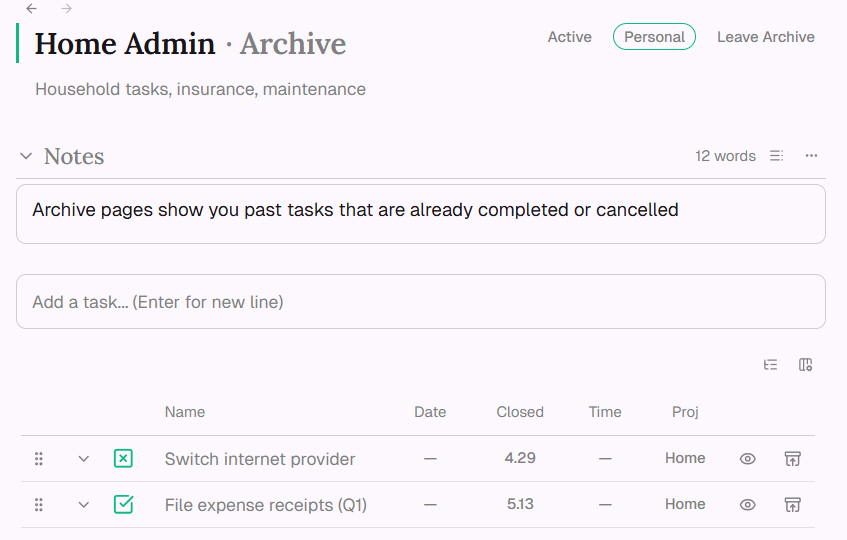
What it is. Checked Off has three distinct ways to remove something from view, each meaning a different thing. Remove from daily list takes a task off today without touching the project. Shelve takes a task or a whole project out of all planning views but keeps it searchable - the move is reversible and visible. Archive hides it from search by default; retrieval is explicit. Together they let you stop working on something without pretending you finished it and without pretending you never started it.
The problem it solves. Most task managers offer two endings: completed or deleted. Everything in between - the things you thought you’d do and now realize you won’t, the project that made sense in January but not in April, the routine you needed during one life phase and not the next - has to be dishonestly miscategorized. You either pretend it’s done, or you delete it and quietly admit you gave up.
This is a real cost. Users learn that their task list is a record of failure, and the rational response is to stop keeping one honestly. The tool designed to help you track your intentions gradually becomes a place you don’t want to look.
The research behind it. Research on self-concordance (Sheldon and Elliot, 1999) shows that abandoning a goal that no longer aligns with the person you’ve become is not only acceptable but adaptive - it is what healthy, well-calibrated goal-pursuit looks like. The problem is almost never that people abandon goals. The problem is that they cannot abandon goals cleanly, and the residue of dishonestly-categorized abandoned goals distorts every subsequent decision about where to spend attention.
Shelving is designed as a first-class planning act. The framing in-app is explicit: I’m choosing not to work on this now. Not “I gave up.” The act of shelving is intentional, reversible, and unshamed. Archiving serves the same purpose at a longer horizon. Neither is an exception case bolted onto completion - they are core planning moves, because graceful non-completion is a normal planning outcome, not a rare one.