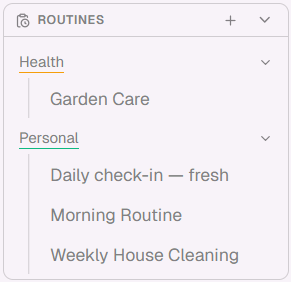
What it is. When a Checked Off routine activates for the day, the daily view does not show the full list of items. It shows one - the next one. Completing it, skipping it, or marking it forgotten surfaces the next. When the last item due that day is done or handled, the routine disappears from view and reappears on the next scheduled day.
The problem it solves. A routine that shows its full list at once is a routine that displays its total weight at every glance. For a simple two-item routine this is fine. For the realistic case - a morning routine with eight to twelve items, a gym program with seven exercises, a housework day with a dozen tasks - the full list is itself the problem. You see it, you feel the weight of everything you haven’t done yet, and the first item becomes harder to start because it is framed as the first of many rather than as itself.
The stronger version of this problem is for users who already have trouble initiating tasks. A list of twelve items is not twelve starts. It’s one start contaminated by eleven reminders of how far from done you are.
The research behind it. The general principle is that decision and attention load are real costs, and reducing the number of simultaneous items in view reduces both. Gloria Mark’s attention research (Mark, 2023) has documented how fragmented attention and high visible workload interact to degrade both performance and subjective experience. The work on choice and decision fatigue, though parts of the literature are contested, consistently finds that a smaller immediate choice set produces both more action and a better experience than a larger one, even when the larger one contains strictly more options.
There is also an executive function dimension. For brains that struggle with initiation, reducing what you have to look at to exactly the next action is not a cosmetic choice - it is the difference between starting and not starting.
Checked Off’s one-item-at-a-time routine view is a direct application. The full list exists in the routine’s definition. It is never the thing you look at while doing the routine. What you look at is this item, now, and then the next one. The routine is a sequence, not a dashboard.