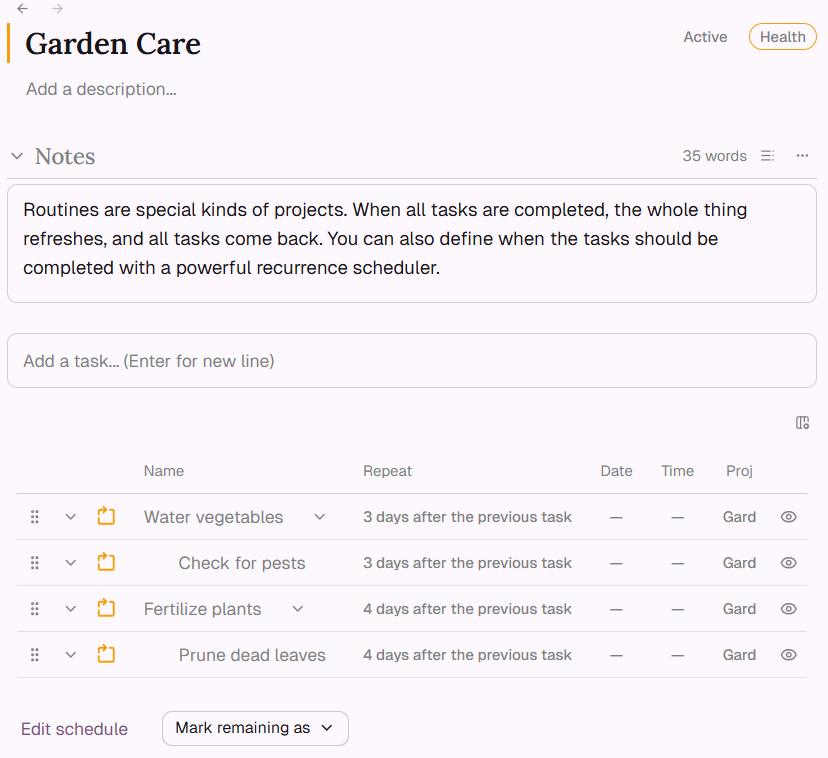
What it is. A Routine in Checked Off is a first-class project type - a scheduled series of items that surface one at a time on the days they’re scheduled. You can give each item its own detail text (reps, weight, instructions, notes to yourself), assign different items to different days, skip an item, or mark it as forgotten. A routine never accumulates a missed-item backlog when you skip a day or step away for a week.
Other task managers either don’t have real routines or treat them as a long recurring-task list. Checked Off treats them as the primary mechanism for getting complex behavior to happen reliably.
The problem it solves. The productivity world’s default advice is: build habits. James Clear’s Atomic Habits (Clear, 2018) made the case beautifully - small behavior, consistent context, clear cue, dopamine-driven encoding, and eventually the behavior becomes automatic. The scaffolding comes down.
There are three ways that model breaks. The behavior is too complex for a single cue-response loop to encode. The person doesn’t repeat it long enough - Lally and colleagues (2010) found real-world automaticity took anywhere from 18 to 254 days, with a median of 66. Or the person’s dopamine system doesn’t run the encoding process reliably in the first place, as is the case for ADHD and several other conditions.
In all three cases, the scaffolding never comes down. Which means habit design optimized for scaffolding removal is the wrong design.
The research behind it. The reframe is this: a habit is a routine where the scaffolding has dissolved. A routine is a habit with the scaffolding still built in. For simple behaviors in stable contexts, the scaffolding can eventually come down and what’s left is what we call a habit. For complex behaviors, and for brains that don’t encode reliably, the scaffolding stays - not as a temporary crutch but as the mechanism itself.
Checked Off’s routines are designed for permanence. One item at a time so the full list never overwhelms. Scheduled by day so the routine only appears when it’s due. Skip and forgot are first-class states, not failure states. No backfill when you miss a day, because a stack of missed instances is punishment, not planning. Completion analytics so you can see whether a routine is actually working for you - the one place in the app where productivity assessment is intentional.
For more on the habits-vs-routines reframe, see Routines Are Just Habits With the Scaffolding Still Built In.