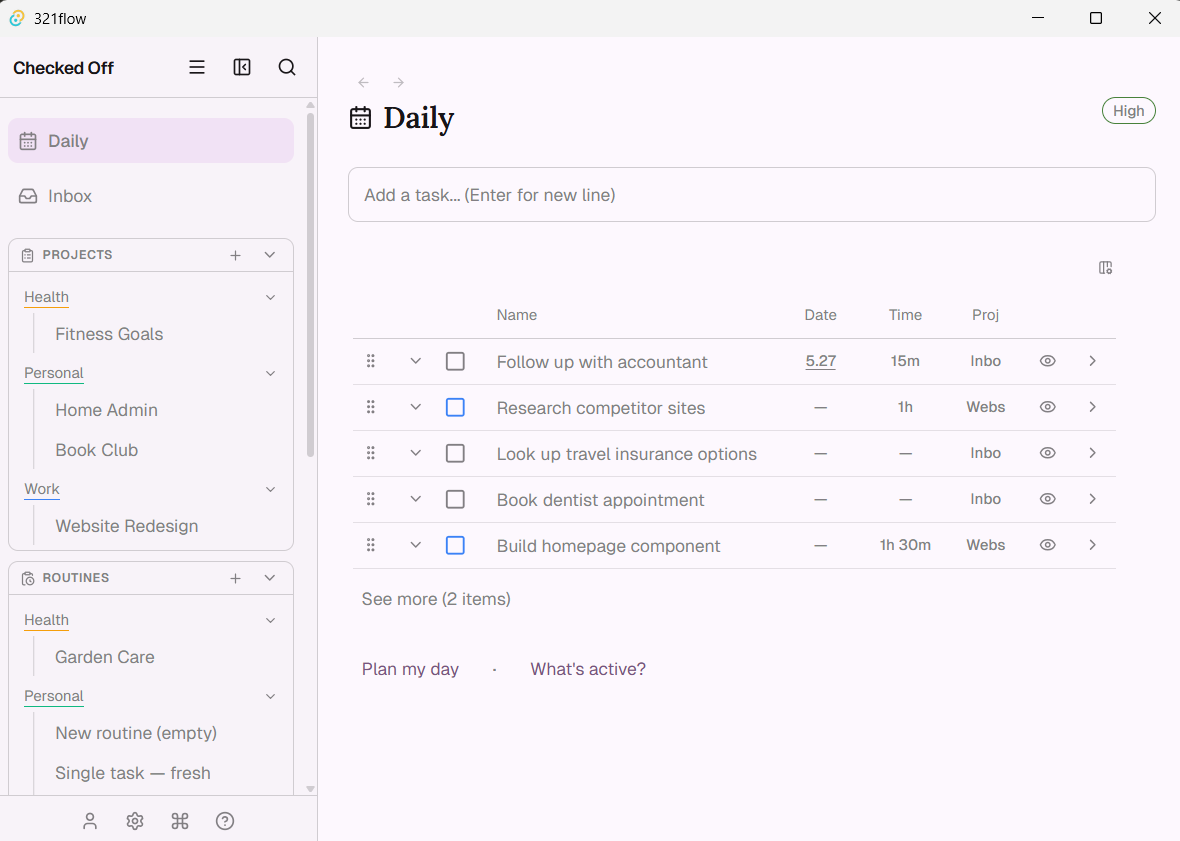
What it is. If you have a daily routine item - log expenses, take meds, stretch - and you miss three days, Checked Off does not give you three instances of it to work through. You get one. The current one. Same for recurring tasks: if today’s instance isn’t completed, the app doesn’t quietly stack yesterday’s and the day before’s behind it. There is always exactly one live instance of a recurring thing, and it is always the current one.
The problem it solves. Most task managers with recurring tasks accumulate missed instances by default. You come back after a week and there are seven “take vitamins” checkboxes staring at you. This is blame design. The user is not going to take seven days of vitamins today. The seven checkboxes exist to make the user feel bad about the past, which is neither useful nor kind, and there is no planning move that responds to it - you can only dismiss.
The effect is worse than it looks. A stack of missed instances is the visible form of an invisible feeling: I am behind. Research on procrastination shows that the emotional weight of being behind is itself a driver of further avoidance (Sirois and Pychyl, 2013). The tool that is supposed to help you get things done is actively producing the affect that keeps you from opening it.
The research behind it. Bluma Zeigarnik’s original finding (Zeigarnik, 1927) was that uncompleted tasks stay active in memory in a way completed ones do not - they keep consuming attention until they’re resolved. Later work complicated the effect, but the core observation holds: unfinished business takes up mental space. What productivity tools have mostly done with this finding is display the unfinished business back to you more aggressively, as if higher visibility would accelerate closure. The opposite tends to be true. Visibility of accumulated unfinished items increases avoidance (Sirois and Pychyl, 2013), not engagement.
Checked Off’s rule is simple and absolute: no backfill, no accumulation, no shame stack. Three missed log-expenses tasks is wrong design. One current instance is always correct. The past doesn’t return as a to-do list. It stays in the past.