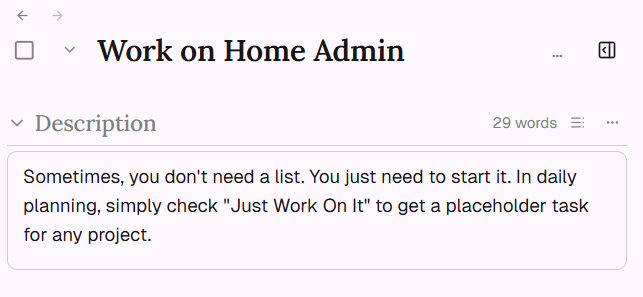
What it is. Alongside the standard task (a concrete next physical action) and the routine item, Checked Off has a third task type: “make progress on.” It’s a time-allocation commitment rather than a defined deliverable. You can give it an optional duration - spend two hours on the thesis, an hour on the business plan - and what you actually do in that time isn’t defined upfront. It’s completable in a day. If you don’t finish, it carries forward at your choice, with an adjustable duration.
The problem it solves. GTD’s next-action principle is correct and load-bearing: a task should be a single physical action, not a goal or an outcome. “Write the thesis” is not a task. “Draft the methods section” might be a task, but only if you already know what’s going on in it - otherwise it isn’t actionable either.
The problem is that a lot of real knowledge work does not decompose cleanly into next actions in advance. Sometimes the actual next action is “sit with this and figure out what it even is.” Sometimes you know the work needs time but you don’t yet know the shape of what you’ll do in the time. Forcing every open-ended effort to be written as a concrete deliverable produces either false concreteness (a fake task you invented so the system would accept it) or nothing at all (you gave up on tracking that kind of work).
The research behind it. The honest planning unit for a lot of creative, investigative, and open-ended work is not an action. It’s an allocation. Researchers working on planning and estimation have long noted that people’s actual forecasts about their own work tend to be time-based, not task-based - “I’ll give this an hour” is the natural form, and the planning fallacy (Buehler, Griffin, and Ross, 1994) shows up most aggressively when people are forced to commit to a completion estimate instead.
Cal Newport’s deep work framework (Newport, 2016) is essentially a time-allocation model dressed in task-list vocabulary: the block of time is the unit, and what happens inside it is allowed to be exploratory. David Allen (Allen, 2001) himself notes that not every input in your system can be a next action - some things are placeholders for attention, not execution.
Checked Off formalizes this. “Make progress on” is a legitimate task type, counted as one task by the daily number picker, with its own duration and its own completion semantics. It lets users plan the work that refuses to be pre-decomposed without forcing a fiction.